
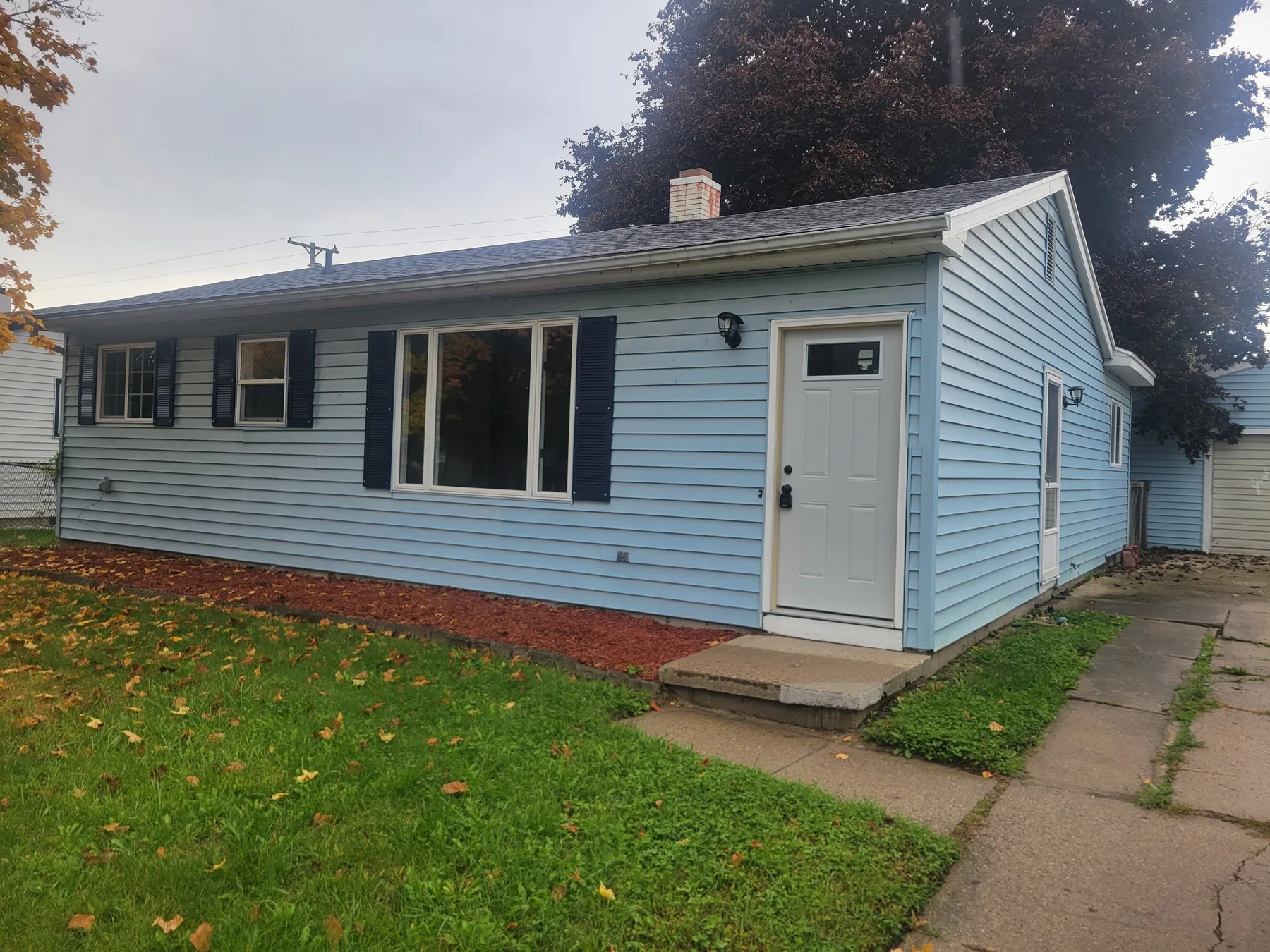
The property
A Nearly Turnkey House Can Still Be the Wrong Investment
We recently toured a property on 15XX Grayfriars Ave in Holt, Michigan as a potential We Buy Lansing investment.
We like this part of Holt for rental analysis because many of the surrounding neighborhoods contain relatively similar single-family homes. Compared with some older Lansing housing stock, properties here can also be somewhat easier to evaluate from a condition and long-term ownership standpoint.
This particular house wasn't what people normally picture when they hear “cash home buyer.” It wasn't a wreck.
The house had already received several updates. The roof was reportedly newer. The interior was in good condition. It had a detached garage, usable basement space, and relatively little work that appeared necessary before someone could occupy it.
We Buy Lansing doesn't only evaluate distressed houses. We look for properties where the economics and potential return make sense.
Sometimes the opportunity is repairing a severely neglected property. Sometimes it's changing how a property is used. And sometimes the house is already perfectly serviceable and the only meaningful lever left is the price.
15XX Grayfriars looked like the third kind.
1 · Operating economics
Could 15XX Grayfriars Work as a Rental?
We started with the property's operating economics before debt. We conservatively underwrote market rent at $1,500 per month, or $18,000 per year.
Directly comparable single-family rental inventory was limited. We deliberately did not raise the rent assumption just to make the investment work.
| Assumption | Annual amount |
|---|---|
| Potential rental income | $18,000 |
| Vacancy | − $900 |
| Insurance | − $1,500 |
| Property taxes | − $6,120 |
| Rental registration | − $143 |
| Repairs & maintenance | − $900 |
| Property management | − $1,800 |
| Net operating income (NOI) | $6,637 |
| Normalized CapEx allowance | − $2,200 |
| Unlevered property cash flow | $4,437 |
These are underwriting assumptions rather than actual future results. “Unlevered” means before mortgage payments.
We include professional property management even if we could manage a property ourselves. We want to understand what the property produces without assuming our own labor is free.
NOI is the income remaining after normal operating expenses but before financing and larger capital expenditures. We then separately included approximately $2,200 each year as a normalized allowance for larger items that occur over time.
Limited directly comparable single-family rental inventory was available, so we used a conservative estimate rather than forcing a higher rent into the model.
The $1,500 figure was not verified by an executed lease.
2 · Return at the asking price
The Asking Price Didn't Produce Enough Return
Cap rate is useful, but incomplete. We also modeled a five-year unlevered internal rate of return, or IRR.
Unlevered means we evaluate the property before introducing a mortgage. This helps us determine whether the real estate itself works before financing changes the return on our cash. IRR is an annualized way of comparing the timing of the initial investment, annual cash flows, and eventual sale proceeds.
At approximately the original asking price around $195,000, the modeled five-year unlevered return was approximately 3.7% under our assumptions.
That wasn't enough for us.
Owning a rental involves vacancy risk, repairs, tenants, illiquidity, management, and unexpected capital needs. A low-single-digit projected return did not adequately compensate us for those responsibilities.
This is our underwriting requirement, not a statement that every investor should require the same return.
3 · Finding the lever
So What Lever Could We Pull?
Investors can generally improve an investment through some combination of:
- higher income
- lower expenses
- physical improvements or value creation
- a different use
- better financing
- a lower acquisition basis
Most of those did not look compelling here. The house was already close to turnkey. We did not see an obvious $20,000 renovation that would create proportionately more rent or value. We also refused to simply assume higher rent.
That left the most important lever: purchase price.
The best value-add we found wasn't renovation. It was basis.
Why We Thought Price Might Be the Lever Worth Testing
Publicly available property information indicated that the property was held in a trust and that the property-tax mailing address was in California.
Those facts do not establish financial distress or seller motivation.
They did give us a reason to consider whether an out-of-state owner might value a different transaction structure than a local owner occupying the property. Potential considerations could include certainty, an as-is transaction, avoiding continued remote ownership, flexible closing, or simplicity.
We had no evidence that any of those were actually priorities for this owner.
Our underwriting tells us what we can pay. It doesn't tell us what an owner should accept.
The next question would have been whether our required price and the owner's priorities happened to overlap.
4 · Price sensitivity
Around $150,000, the Math Changed
| Measure | Calculated result |
|---|---|
| Net operating income | $6,637 |
| Cap rate on total initial investment | 4.3% |
| Cash flow after normalized CapEx | $4,437 |
| Unlevered cash yield | 2.9% |
This still isn't an extraordinary cash-flow rental. The more important change occurs if our independent valuation supports approximately $195,000 of current market value.
Separate inputs
- Hypothetical acquisition price
- ~$150,000
- Initial investment / basis
- ~$153,600
- Estimated current market value
- ~$195,000
Purchase price and market value are separate inputs. We did not project future value by appreciating the $150,000 acquisition price. The $195,000 value is an underwriting assumption, not an appraisal or guaranteed sale price.
Five-Year Unlevered Model
| Input or output | Amount |
|---|---|
| Initial investment | $153,600 |
| Current estimated market value | $195,000 |
| Year-one unlevered property cash flow | $4,437 |
| Annual cash-flow growth | 3% |
| Annual property appreciation | 3% |
| Holding period | 5 years |
| Selling costs | 6% |
| Year 5 estimated gross value | $226,058 |
| Estimated selling costs | − $13,564 |
| Estimated net sale proceeds before taxes | $212,495 |
| Five-year unlevered IRR | 9.4% |
The IRR uses annual end-of-year property cash flows growing 3%, plus the modeled net sale proceeds in year five. Taxes and transaction-specific tax effects are excluded.
This is where buying below our estimate of market value changes the investment. We aren't relying on renovation to create the spread. The potential value creation occurs at acquisition.
Sometimes value-add means fixing the house. Sometimes it simply means buying well.
5 · Financing sensitivity
What If We Used Debt?
Financing can make a percentage return look much larger without improving the property itself. We modeled a conventional mortgage only to separate the property economics from the effect of leverage.
| Financing input | Amount |
|---|---|
| Purchase price | $150,000 |
| Down payment | 20% / $30,000 |
| Loan amount | $120,000 |
| Interest rate | 7% |
| Amortization | 30 years |
| Calculated principal & interest | $798.36 / month |
| Calculated annual debt service | $9,580.36 |
This is negative leverage from an operating-cash-flow perspective. Debt did not make the rental operation better. The property would require additional cash from the owner.
What Leverage Did to the Modeled Return
The down payment plus the assumed acquisition and rental-ready costs produces approximately $33,600 of initial equity invested. After 60 monthly payments, the calculated mortgage balance would be approximately $112,958.
| Calculated item | Amount |
|---|---|
| Initial equity invested | $33,600 |
| Year-one cash flow after debt | − $5,143 |
| Year 5 net sale proceeds before debt payoff | $212,495 |
| Remaining mortgage after five years | − $112,958 |
| Estimated sale equity after mortgage payoff | $99,537 |
| Five-year levered IRR | 14.7% |
The levered IRR uses the $33,600 initial equity investment, annual cash flow after debt service, the calculated loan amortization, and year-five net sale proceeds after selling costs and mortgage payoff. It excludes income taxes and transaction-specific tax effects.
A higher levered IRR does not mean the property suddenly became a better rental.
Leverage allows less equity to control the asset. That can magnify returns, and it can magnify losses. Under these assumptions, the property still operates at a cash deficit after debt service.
6 · Investor fit
Who Might Actually Want This Investment?
This property is probably not ideal for an investor whose primary goal is current monthly cash flow. It could fit an investor pursuing a leveraged real-asset strategy.
Homeowners usually come to We Buy Lansing for clarity about the property and their selling options. People interested in the capital side of the work may care more about how we evaluate basis, risk, and return. If that is the side you want to explore, see how we work with Lansing real estate investors.
That investor might:
- have substantial outside income and liquidity
- tolerate negative annual property cash flow
- have a long holding period
- want exposure to tangible real estate
- prefer long-term fixed-rate debt
- be concerned about long-term inflation and purchasing power
- value potential rent growth, appreciation, and loan amortization more than immediate distributions
With a long-term fixed-rate mortgage, the debt is fixed in nominal dollars. Rents and property values are not fixed. If inflation persists over a long period, nominal rents, incomes, replacement costs, and property values may rise while the original mortgage balance does not increase.
That does not make this house a guaranteed inflation hedge.
Real Estate and TIPS Do Different Jobs
An investor concerned about inflation has simpler alternatives, including Treasury Inflation-Protected Securities, or TIPS. TIPS have an explicit inflation adjustment tied to CPI and U.S. Treasury backing. A rental house does not.
Real estate introduces vacancy, maintenance, property taxes, insurance, tenant and management responsibility, illiquidity, and uncertain future value.
Leveraged real estate offers a different combination: physical asset ownership, rental income, potential rent growth, potential appreciation, principal amortization, and long-term fixed-rate leverage.
One is not automatically superior to the other. They perform different jobs in an investment portfolio.
Final decision · Pass
Our Decision: We Pass
After working through the numbers, our conclusion on 15XX Grayfriars was simple:
At the right acquisition price, we think this could be a legitimate investment. But it isn't the investment we're looking for right now.
At approximately $150,000, the unlevered return begins approaching our hurdle. Using debt could potentially push the modeled return on equity considerably higher. But the property does not produce positive cash flow under the financing assumptions we modeled.
For our current investment portfolio, that's where we stop.
We pass.
- it is a bad house
- Holt is a bad area
- $150,000 is necessarily a bad acquisition price
- the projected levered return is necessarily unattractive
The source of the return doesn't match how we're currently positioning our investment portfolio.
We currently prefer acquisitions where the property's operating economics can support the financing and produce positive cash flow.
We are happy to benefit from appreciation, inflation, amortization, tax treatment, or favorable leverage. But we don't want those things to be the primary reason a property works.
A good deal can still be a pass.
Underwriting isn't about finding a way to make every property work. It's about understanding exactly how an investment is expected to make money — and deciding whether that matches what you're trying to accomplish with your capital.
For us, 15XX Grayfriars didn't.
So we kept looking.
Transparency note
This case study documents a property We Buy Lansing evaluated as a potential acquisition. We did not purchase the property and did not make an offer. Property values, rents, expenses, financing terms, appreciation, and projected returns shown here are underwriting assumptions used for educational purposes and are not guarantees of future performance.