
Introduction
A Former Rental Property With Two Ways to Sell
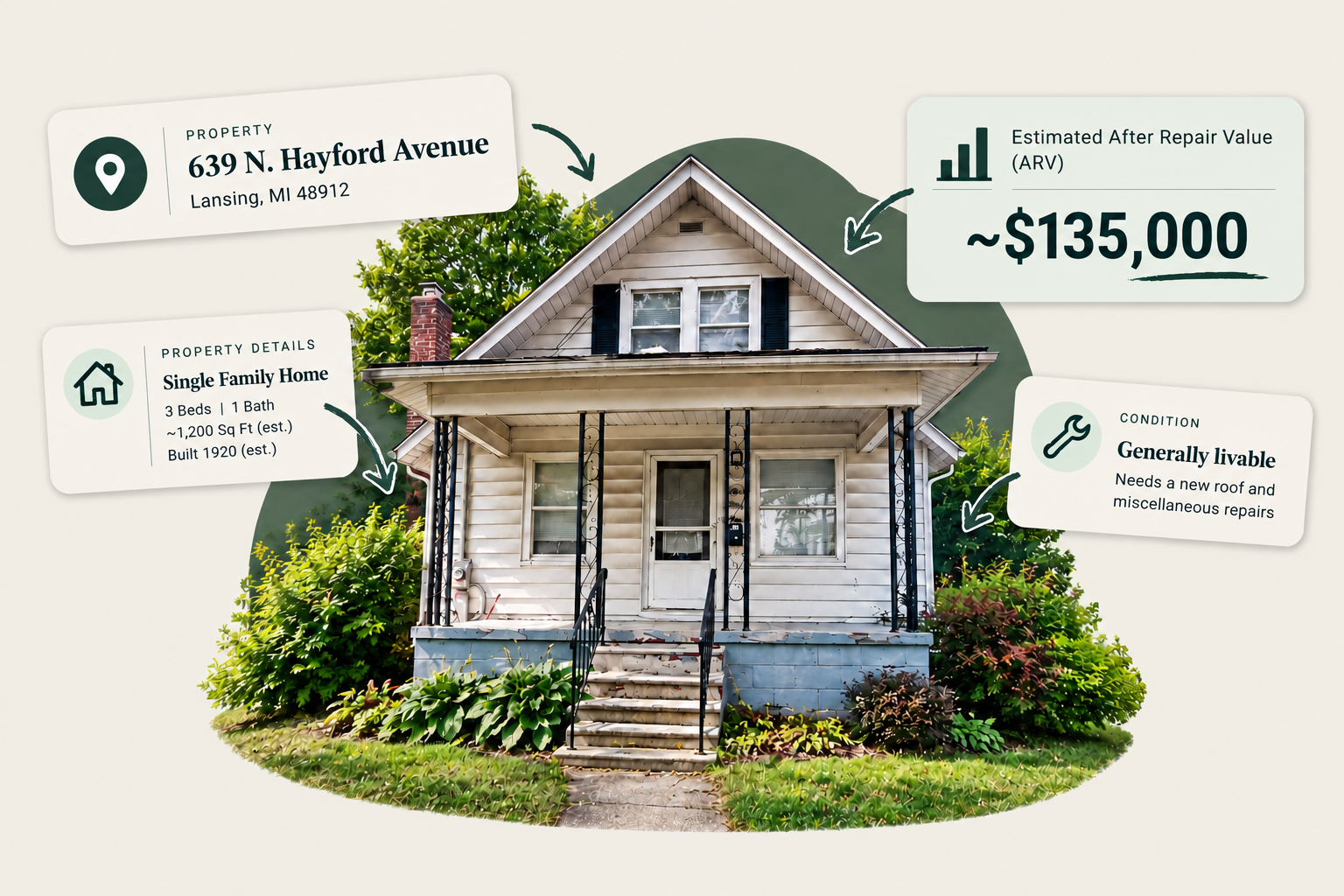
The owners of 639 N Hayford asked We Buy Lansing to evaluate a former rental property in August 2026. We prepared a comparative market analysis, discussed a conventional listing, and proposed a conditional direct purchase at approximately $85,000.
The owners declined our offer and chose to list the house with a real estate agent. As of the November 2026 update, the property is vacant and actively listed at $125,000 after 51 reported days on market.
We do not yet know which path will produce the better final outcome. This ongoing case study preserves the original estimates, explains the tradeoffs we discussed, and will be updated when additional verified market evidence becomes available.
1 · Property background
From an MSU Home to a Rental Property
The owners originally purchased the house while attending graduate school at Michigan State University. Their careers later took them elsewhere, and the property became a rental rather than being sold immediately.
The house was rented to someone the owners knew. Eventually, they decided that continuing to own the Lansing property no longer fit their plans and began evaluating how to sell it.
This is a common path into landlording. Not every rental was purchased as part of a formal investment strategy. A former residence can become a rental because the owner moves, then remain an asset—and an ongoing responsibility—for years.
Owners considering a similar decision can review our guide to selling a rental property in Greater Lansing.
2 · August 2026 analysis
Evaluating the House: Roof, Condition, Location, and Comparable Sales
Our original comparative market analysis was dated August 6, 2026. It used seven nearby closed sales and considered the subject property's condition, location, and marketability rather than treating the median comparable adjustment as the final answer.
The analysis identified several material considerations:
- An aging roof and the potential cost of eventual replacement
- The porch and exterior finishes
- Upstairs flooring that could benefit from replacement
- Electrical service that needed to be restored
- The corner-lot location along Saginaw Street
- The property's overall appeal relative to nearby Lansing houses
The seven adjusted comparable values ranged from approximately $98,500 to $130,500. Their median adjusted value was around $125,900. That median did not automatically establish the subject property's as-is value because the house's own condition and location still mattered.
| Scenario | Estimated gross sale price | What the scenario assumed |
|---|---|---|
| As-is | $115,000–$120,000 | Electrical service restored; otherwise reflecting the property's existing condition |
| Modest cosmetic improvements | Approximately $125,000 | Targeted preparation intended to improve marketability |
| Cosmetic improvements and roof replacement | Approximately $130,000–$140,000 | More capital, project coordination, and execution risk before sale |
These were historical evaluation scenarios, not appraisals, guarantees, or completed-sale prices. Improvements require money and do not necessarily return their full cost. We have not assumed the owners completed any specific improvement after our evaluation.
3 · Two selling paths
The Two Selling Options: Listing or an $85,000 Cash Offer
On August 7, 2026, we provided written selling recommendations and proposed a direct purchase at approximately $85,000. The proposal assumed the electrical service could be restored and that the electrical system would be code-compliant.
The contemplated closing period was approximately 30 days. After anticipated seller-side title and transfer expenses, we estimated that the owners might net approximately $80,000.
It was not an appraisal of retail value, the approximately $80,000 net was an estimate, and the owners had no obligation to accept it.
A conventional listing offered a higher potential gross price and a meaningful possibility of higher net proceeds. It also transferred less preparation and market risk to us. The owners would remain responsible for the property while waiting for an acceptable offer and closing.
The useful comparison was therefore not $85,000 against a $125,000 asking price. It was an estimated $80,000 direct-sale net against the range of possible listing nets after selling expenses, holding time, repairs, concessions, and uncertainty.
4 · Buyer-pool analysis
Why This Lansing House May Fall Between Retail Buyers and Investors
Some lower-priced houses occupy an uncertain middle ground. A modest price may attract owner-occupants, but condition can narrow the number of buyers who are comfortable with the immediate work, financing requirements, and cash needed after closing.
Owner-Occupant Considerations
A homeowner might consider the roof's remaining life, electrical service and inspections, immediate repair costs, available cash after a down payment, and whether the house is ready for occupancy. Conventional, FHA, and VA financing can involve different underwriting and property-condition requirements.
We are not claiming that 639 N Hayford was ineligible for any financing program or that every roof issue prevents mortgage financing. The narrower point is that condition and financing can reduce the number of buyers willing or able to proceed.
Investor Considerations
An investor starts with a different equation: purchase price, repairs, carrying costs, transaction costs, financing expenses, rental or resale potential, required return, and uncertainty about the eventual exit.
A house can be attractive to an owner-occupant at a price that does not leave enough margin for an investor. It can also need too much immediate work for some retail buyers while remaining priced too high for an investor's return requirements.
A property can sit between two buyer markets without being a bad house or a bad investment.
This framework may help explain why some Lansing houses take longer to sell. It is not a verified explanation for Hayford's current status, and 51 days on market does not prove that the property is caught between buyer groups.
5 · Greater Lansing evidence
What Our Lansing Market Research Shows
Our analysis of 3,178 resolved 2025 Greater Lansing single-family listings found that approximately 77% sold under their respective listings. The open market worked for most properties.
The results were less uniform among lower-priced City of Lansing houses:
- Among 444 resolved City of Lansing listings originally priced below $150,000, 316 sold and 128 were canceled, expired, or withdrawn—a 28.8% unsuccessful-listing rate.
- Among 88 resolved City of Lansing listings under $150,000 marketed with investor-related language, 53 sold and 35 were canceled, expired, or withdrawn—a 39.8% unsuccessful-listing rate.
- Of the 53 successful investor-marketed sales, 29 were cash purchases, or approximately 54.7%.
The research also found that simply needing repairs did not, by itself, correspond to an unusually high unsuccessful-listing rate. A house needing work does not automatically belong in a direct cash sale.
Hayford illustrates the kind of property-specific decision that sits behind those group-level results, but the research does not predict this property's outcome. Read the full study, Should You List Your Lansing House or Take a Cash Offer? What 3,178 Listings Show, for the complete data and methodology.
6 · Financial comparison
Comparing Estimated Net Proceeds
For this case-specific listing model, we assumed:
- Real estate agent compensation equal to 6% of the actual sale price
- Transfer taxes of $8.60 per $1,000 of sale price, or 0.86%
- $1,500 of additional title and closing expenses
The 6% figure is a modeling assumption for this comparison, not a required or standard commission. The formula is sale price minus 6% agent compensation, minus 0.86% transfer taxes, minus $1,500 of additional closing expenses.
| Assumed sale price | Estimated net before holding costs |
|---|---|
| $115,000 | $105,611 |
| $117,500 | $107,939 |
| $120,000 | $110,268 |
| $125,000 | $114,925 |
These are hypothetical completed-sale scenarios, not actual outcomes. They exclude holding costs, repairs, buyer concessions, unexpected transaction expenses, income taxes, and the opportunity cost of capital.
Illustrating Time at $117,500
The property has no mortgage, so the holding-cost model does not include mortgage payments, interest, or a loan payoff. It uses a clearly labeled illustrative assumption of $500 per month for possible taxes, insurance, utilities, lawn or seasonal maintenance, winterization or heating, and vacancy-related exposure.
| Total holding period | Illustrative holding costs | Estimated listing net at $117,500 |
|---|---|---|
| 2 months | $1,000 | $106,939 |
| 4 months | $2,000 | $105,939 |
| 6 months | $3,000 | $104,939 |
The scenarios include the initial approximately two months already incurred; they do not add that period twice. The $500 monthly figure is illustrative and does not represent verified owner expenses.
Compared with the original estimated direct-sale net of approximately $80,000, the modeled listing outcomes still show a meaningful potential financial advantage to listing. At a $117,500 sale after two total months of holding costs, the difference would be approximately $26,939 before any unverified repairs, concessions, taxes, or other excluded costs.
The direct purchase also contemplated approximately 30 days to close. A strict comparison from the August decision date should therefore recognize that roughly one month of holding expense could have existed under either path. Not every dollar incurred during the listing period is automatically an incremental cost caused by rejecting the direct offer.
7 · The owners' decision
The Owners Chose to List
The owners declined our direct purchase offer and chose to list the property with a real estate agent. That decision preserved the opportunity to reach a broader buyer pool and potentially produce materially higher net proceeds.
Listing also meant continuing to own the vacant house while it was marketed and moving through a buyer's inspection, financing, appraisal, and closing process if an acceptable offer emerged.
The choice was reasonable. Our $85,000 proposal offered a more certain, lower-preparation path, but the current financial scenarios leave substantial room for a conventional listing to outperform the estimated $80,000 direct-sale net.
8 · Dated market update
November 2026 Update: $125,000 Asking Price and 51 Days on Market
| Listing status | Active |
|---|---|
| Asking price | $125,000 |
| Reported days on market | 51 |
| Occupancy | Vacant |
| Mortgage | None |
The $125,000 asking price is above our original August as-is valuation of approximately $115,000–$120,000, which assumed the electrical service would be restored. We believe the current asking price may be optimistic relative to the property's original condition and market characteristics.
That is an opinion based on the August information—not a prediction of the final sale price. The asking price is not a completed transaction or independently established market value. We also do not know whether the owners completed repairs or improvements after our evaluation.
The 51-day marketing period shows only that the house had not sold under the current listing as of this update. It does not prove the property is overpriced or that the direct offer was financially superior. The owners may still achieve materially higher net proceeds through the conventional market.
9 · Continuing ownership
What Happens While a Vacant House Remains on the Market?
Without a mortgage, the largest monthly payment is absent. Other ownership costs and risks can continue:
- Property taxes and insurance
- Electricity, gas, water, and heating
- Lawn care and seasonal maintenance
- Winterization and monitoring
- Unexpected repairs or weather-related damage
- Vacancy-related security and insurance exposure
Receiving an offer would not necessarily end those costs immediately. Inspection, appraisal, financing, title work, and closing can extend the period of ownership. At the same time, the potential listing premium can be large enough to justify that wait.
The decision depends on the actual offer, the probability of closing, the owner's carrying costs and tolerance for uncertainty, and the work still required—not only the number of days shown on a listing.
10 · Ongoing evidence
What We'll Learn From the Final Sale
The final outcome will provide better evidence than the current asking price. Future dated updates may document a price reduction, pending or contingent status, withdrawal or expiration, a verified final sale price, and the total marketing period.
If the property sells, the useful comparison will be the verified sale price and available transaction facts against the original August estimates—not a claim that one decision was always obvious.
We will preserve the original evaluation when adding later updates so readers can see what was known at the time and how the actual market result developed.
Conclusion
The Right Selling Decision Depends on More Than the Asking Price
A direct purchase offered the Hayford owners a conditional path at approximately $85,000, with an estimated seller net of about $80,000 and an anticipated closing period of approximately 30 days.
Listing created a meaningful possibility of higher net proceeds. It also required more time, continued ownership, market exposure, and an eventual buyer willing and able to complete the transaction.
The difference between the two routes should be tested through expected net proceeds, preparation, carrying costs, certainty, work required, and the owner's priorities. The evidence may ultimately show that listing was the financially stronger choice. That would be a useful and legitimate outcome of this case study.
Homeowners can use our selling-options comparison and property evaluation process to examine the same questions for another Greater Lansing property.
Transparency note
This ongoing case study documents a real property evaluation and historical offer. Valuation ranges, selling-cost assumptions, holding costs, and net proceeds include estimates that may differ materially from actual results. The analysis is not an appraisal, legal advice, tax advice, or a guarantee of value or transaction outcome.