

This story is shared without the homeowner's or family member's name. It documents a real Lansing property evaluation and the help provided before the family chose how to proceed.
1 · The situation
A Move for Care Left a House to Resolve
An older mother needed to leave Lansing and move to Ohio for long-term care and to be closer to family. Her daughter-in-law lived in Ohio, so the Lansing house became one of the practical issues the family needed to resolve from another state.
The purpose of our conversation was straightforward: inspect the house, review the local market, explain what we believed the property could realistically produce through different sale routes, and make a direct cash offer the family could consider.
The care transition created the reason for addressing the house, but the property still needed to be evaluated on its own condition, layout, and local market evidence.
2 · The property
An Older, Cared-For House With an Unusual Layout
531 Winifred Avenue was older and somewhat dated, but it had generally been cared for. It needed repairs, cleanup, and updating. It was not a severely distressed house.
The original structure was a relatively small two-bedroom home. A later addition substantially increased the living space. That extra space was useful, but it also created a less conventional configuration and left relatively little backyard.
That mattered when selecting comparable sales. Similar total square footage does not automatically make two homes directly comparable. A conventional home and a smaller original house with a large addition may appeal to buyers differently, even when the reported living areas look similar.
3 · Understanding the value
Renovated Value Was Not Current Value
Renovated or stronger-condition comparable properties suggested that an improved version of the house could potentially support approximately $180,000–$200,000.
That did not mean the property was worth $180,000–$200,000 in its existing condition.
After visiting the home and focusing on sales that better reflected its condition and configuration, we believed a traditional open-market sale around approximately $135,000–$140,000 was realistic with relatively basic preparation.
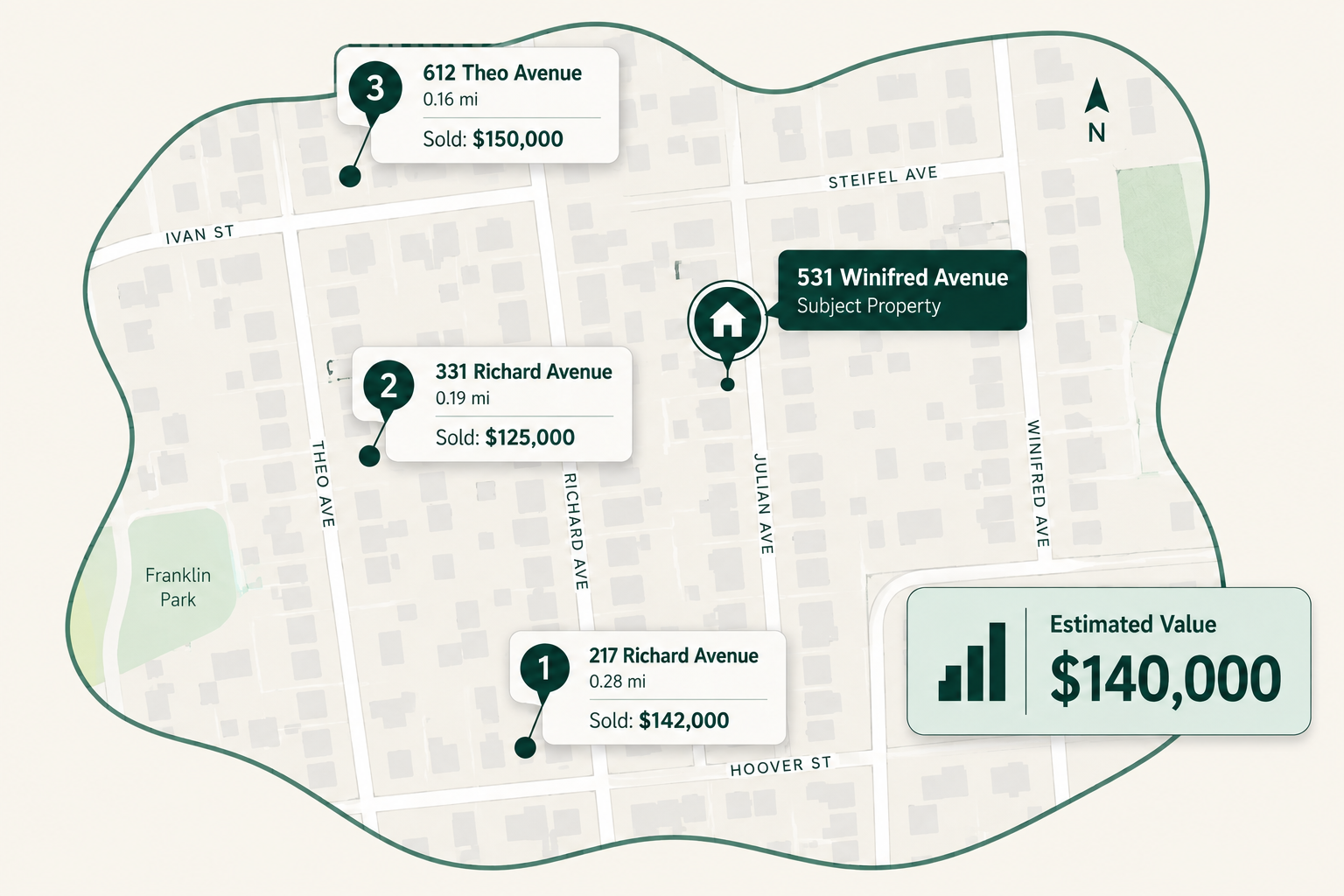
| Evaluation | Approximate range | What it assumed |
|---|---|---|
| Potential renovated value | $180,000–$200,000 | Improved condition supported by stronger renovated comparables |
| Likely open-market sale | $135,000–$140,000 | Relatively basic preparation, normal marketing, and a retail buyer |
| Our direct cash purchase range | $95,000–$100,000 | As-is purchase, no full cleanout or retail preparation, and flexible timing |
These ranges were property-evaluation estimates based on the information available at the time. They were not appraisals, guarantees, or statements of a final sale price.
We did not recommend that the family undertake a major renovation merely to chase the highest theoretical resale value. The cost, time, coordination, and uncertainty of a large project did not appear necessary to reach a reasonable market outcome.
4 · Our offer
We Made an Offer and Explained the Tradeoff
Our direct cash purchase range was approximately $95,000–$100,000. Under a direct sale to us, the family would not have needed to fully clean out the house, renovate it, repair the sink, or prepare it for normal retail showings. We could also work around their preferred timeline.
As part of that conversation, we told the family what we believed the home could probably produce on the open market and whether spending money on repairs appeared worthwhile. The likely listing outcome was higher than our direct-purchase range because the two routes involved different work, timing, uncertainty, and transaction responsibilities.
The family had our actual offer, our view of a realistic open-market range, and an explanation of what each path would require.
That is also how our property evaluation and offer process is intended to work. We are a home-buying company, but we will still tell someone when we believe basic preparation and an open-market sale could probably produce more money.
5 · The family's decision
The Family Found Another Cash Buyer
While the family was evaluating its options, a personal connection knew someone who was looking for a house.
The family told us that this buyer made a somewhat higher cash offer than ours and, like us, would cover closing costs. The family felt comfortable with that buyer and decided to move forward with them.
We do not have confirmation that the other transaction closed, so this story does not claim that the house sold or identify a final sale price. The documented outcome is that the family received another offer and chose that buyer.
That was a reasonable decision. Another buyer simply offered terms the family preferred.
6 · The human part
The Evaluation Still Helped
After deciding to use the other buyer, the homeowner's daughter-in-law told us that she appreciated our help with the process and the services we provide for older adults. She also explained that the other buyer had offered somewhat more and would cover closing costs.
It came from a family that did not accept our offer. The useful part of the interaction was the inspection, the local market context, and having a real offer to compare—not pressure to choose us.
For a family handling a care transition from another state, clear information can reduce one part of a much larger decision. It does not remove the work or emotion involved, but it gives the family a more grounded way to compare the available paths.
7 · The lesson
A Cash Home Buyer Does Not Need to Buy the House for the Conversation to Be Useful
Sometimes selling directly makes sense. Sometimes doing basic preparation and listing the property is likely to produce more money. Sometimes another buyer simply offers more.
We Buy Lansing can still provide a useful property evaluation and a real offer that gives the homeowner something concrete to compare. Not every evaluation becomes a We Buy Lansing acquisition.
For families trying to sell a parent's house to help pay for care in Lansing, the right next step depends on the property, the family's capacity to prepare it, the timing, and the offers actually available.
The Winifred family had enough information to choose the buyer and structure they preferred. That was the point of doing the evaluation carefully.