Our offers take many forms and shapes. They are developed through a balance of control, responsibility, risk, certainty, potential proceeds, and your situation.
Our job is not to force every situation into a cash offer. It’s to identify the option that best fits your goals. Read about our philosophy.
Sometimes our offers take various shapes. They may be:
- A direct purchase
- Partnership or creative structure
- A traditional listing
The right solution depends on the property, the people involved, the financial reality, the timeline, and the amount of risk that needs to be transferred.
Each option allocates risk and equity differently. The simple rule is that equity tends to follow where the risk is.
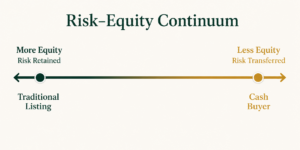
Here is a deeper dive into understanding the different offers you may see.
Option 1: Direct Purchase
In many situations, a direct purchase solution is the cleanest and most preferred.
This may make sense when the owner wants certainty, speed, convenience, or does not want to handle repairs, cleanout, showings, inspections, or financing delays.
In this scenario, we assume the risk, fund the repairs, manage the project, and the seller is able to move forward.
This is often the most common. It works when people have enough equity in the home for all of the risk to become transferred.
Option 2: Partnership Or Creative Structure
Occasionally, a situation may call for something more creative.
This could involve shared risk, repair funding, delayed payment, a partnership structure, seller participation, or another arrangement where the owner may retain some involvement instead of simply selling outright.
These situations are less common because they require more trust, more structure, and more risk management.
But when the numbers do not support a simple purchase, a creative solution may be worth discussing.
Option 3: Traditional Sale
Sometimes the best solution is not an investor offer.
If the property is likely to perform well on the open market, a traditional sale may create more value for the homeowner.
In those situations, we believe the homeowner should understand that option before making a decision.
Not every house should be sold to an investor.
Disclaimer: We Buy Lansing is a cash-buyer real estate investor site. Offers may be made through various partners or entities. You can read more about our offer disclosures.
Why Are Cash Buyer Offers So Low?
Our offer philosophy is to give you an offer that is fair to you and accounts for the risk absorbed on our end.
Every option allocates risk and equity differently.
In general, equity tends to follow risk.
If you keep the risk, you usually keep more of the equity.
If someone else takes the risk, they usually receive some of the equity in return. The party who takes the risk gets the reward if things go well — and absorbs the loss if things go badly.
That’s why a cash buyer’s offer is often lower than what a home might eventually sell for on the open market. The cash buyer is accepting the uncertainty, cost, time, and responsibility that the seller no longer wants to carry.
Why A Simple Formula Is Not Enough
Many investors look at a house through one basic lens:
- Buy low.
- Fix it.
- Sell it.
- Make a profit.
Often, they use the formula “After-Repair Value” or what the home could sell for if it was all fixed up. Then they subtract their costs (repairs, holding costs, financing costs, selling costs) and lastly their desired profit.
That model can work for certain properties, but it does not solve every situation.
A homeowner with significant equity may need a different option than someone who is behind on payments.
A family settling an estate may need a different path than a landlord who wants to retire.
A caregiver helping an aging parent may need flexibility more than speed.
A property with repair issues may need capital, but not necessarily a full sale.
That is why we do not believe every situation should be forced into one formula.
Need Guidance
Are you unsure if a direct-purchase offer is best for you. Alex Craig and the team at Dolinski Advisory (also known as Dolinski Group) can help walk you through the various options and numbers. Dolinski Advisory focuses on helping people understand the tradeoffs between price, risks, repairs, and cash flow. Ultimately, they present your options in a low-pressure way. Their work is guided by the Home Transition Advisor Framework.